Home/The author
Professor of Medical Genetics · Author

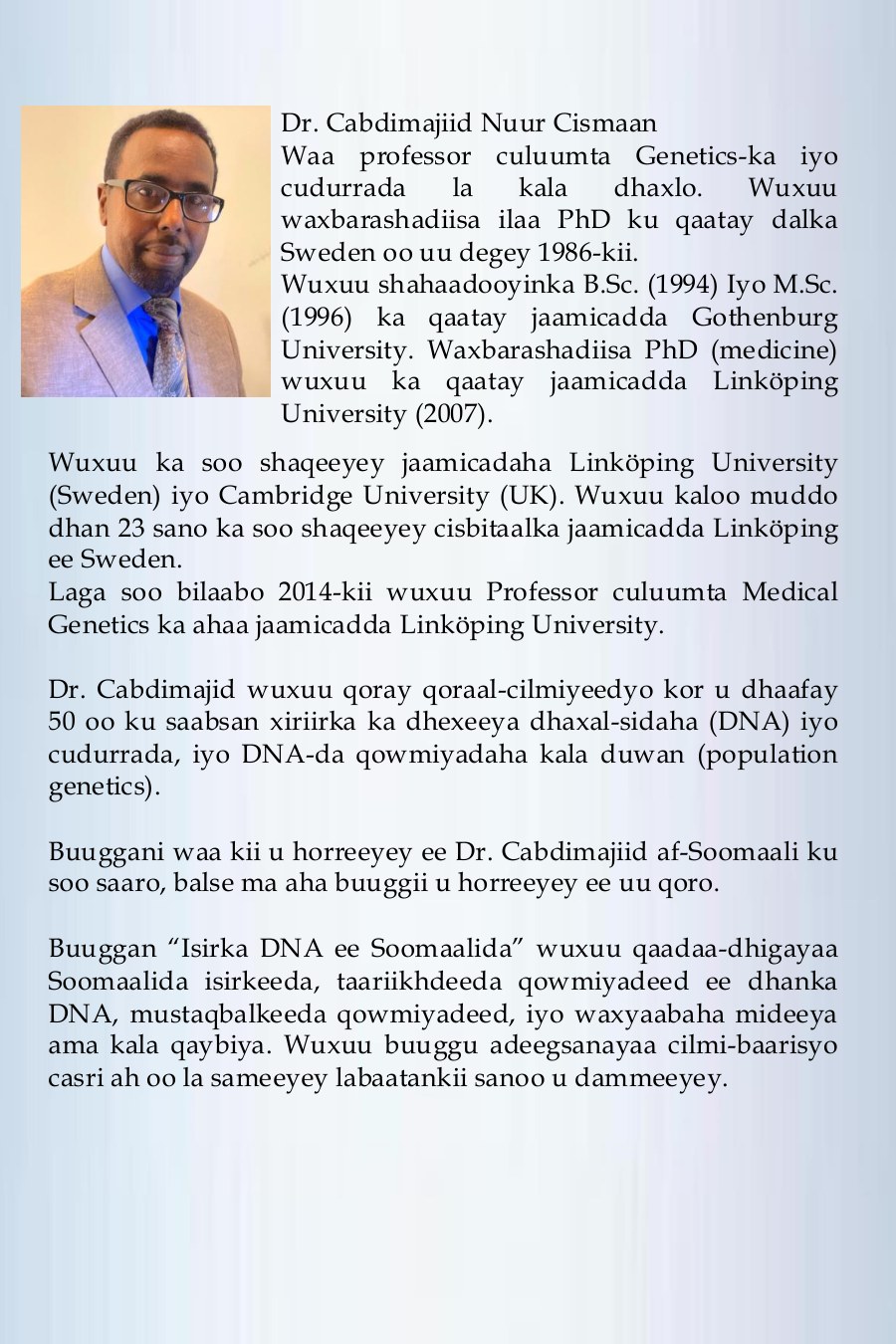
Prof. Dr. Abdimajid Nur Osman

Cabdimajiid Nuur Cismaan

A professor of medical genetics and inherited disease, with 23 years at Linköping University Hospital and pioneering genome research on the Somali population.

Prof. Dr. Abdimajid Nur Osman
25+
Peer-reviewed articles
23
Years in clinical genetics
18
Journals he reviews for
2016–22
Somali genome research
Biography

A life in genetics

I hope this book becomes a guide for the Somali community — to discover their origins and the future of their nation.

Prof. Abdimajid Nur Osman (Cabdimajiid Nuur Cismaan) is a professor of medical genetics and inherited disease. He settled in Sweden in 1986, earned his B.Sc. (1994) and M.Sc. (1996) at the University of Gothenburg, and completed his PhD in medicine at Linköping University in 2007.

He has worked at Linköping University and the University of Cambridge, and spent 23 years at Linköping University Hospital as a clinical scientist specialising in human genetic disorders. From 2014 he was Associate Professor of Medical Genetics at Linköping University, and since 2023 he has directed Cidlogenomics, a consultancy for genomic medicine.

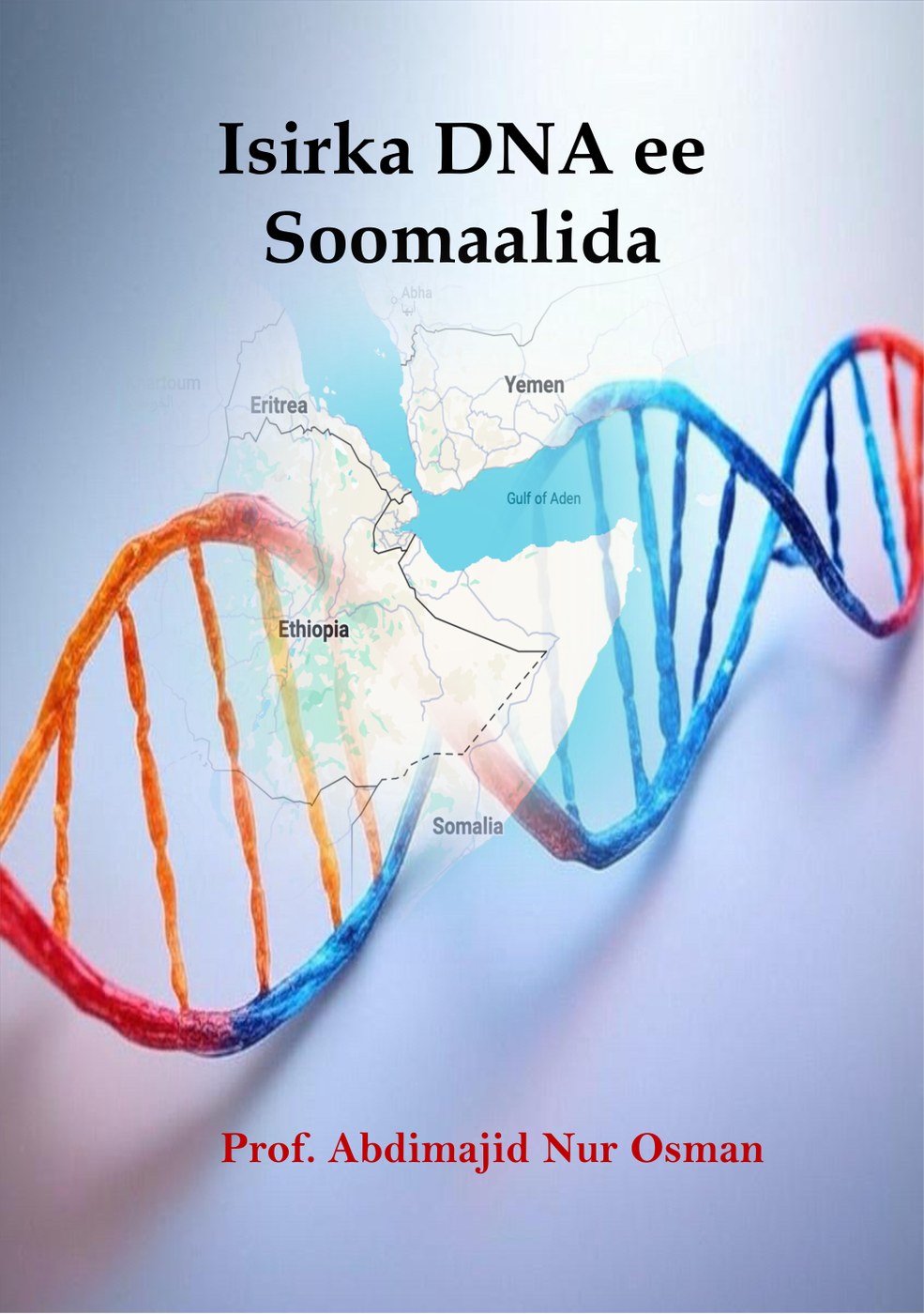
His research spans the links between DNA and disease, pharmacogenomics and population genetics — including genome-wide studies of the Somali population carried out between 2016 and 2022. Isirka DNA ee Soomaalida is his first book written in Somali.

Career & education

The journey

2023 – present

Director

Cidlogenomics, Linköping

Consultancy specialising in genomic medicine.

2018 – 2022

Adjunct Professor of Clinical Biochemistry

Linköping University Hospital

Professorship linked to his clinical position at the hospital.

2014 – 2022

Associate Professor of Medical Genetics

Faculty of Medicine, Linköping University

Principal investigator in medical genomics and pharmacogenomics.

2009 – 2018

Senior Lecturer

Faculty of Medicine, Linköping University

Taught medical genetics and medical bioinformatics; supervised PhD and master's students.

1999 – 2022

Senior Clinical Scientist

Linköping University Hospital

Department of Laboratory Medicine — expertise in human genetic disorders.

2008

Post-doctoral research

University of Cambridge, Department of Haematology

UK-wide research on genetic markers for cardiovascular disease.

1998 – 1999

Research Biochemist

AstraZeneca, Gothenburg
2003 – 2007

PhD, Clinical Biochemistry / Pharmacogenomics

Linköping University

Thesis on inter-individual variation in warfarin treatment.

1994 – 1996

M.Sc. in Biochemistry

University of Gothenburg
1990 – 1994

B.Sc. in Biomedical Sciences

University of Gothenburg
Books

Written by Abdimajid Nur Osman

Selected research

Scientific publications

2022

Cross-ethnic analysis of common gene variants in hemostasis show lopsided representation of global populations in genetic databases

BMC Medical Genomics · Featured
2020

Genome-wide analyses disclose the distinctive HLA architecture and the pharmacogenetic landscape of the Somali population

Scientific Reports · Featured
2017

Prevalence of common hereditary risk factors for thrombophilia in Somalia and identification of a novel Gln544Arg mutation in coagulation factor V

Journal of Thrombosis and Thrombolysis · Featured
2020

Platelet pathogen reduction technologies alter the microRNA profile of platelet-derived microparticles

Frontiers in Cardiovascular Medicine
2019

Assessment of genetic and non-genetic risk factors for venous thromboembolism in glioblastoma — the predictive significance of B blood group

Thrombosis Research
2018

Frequency of PAR4 Ala120Thr variant associated with platelet reactivity significantly varies across sub-Saharan African populations

Blood
2018

The platelets' perspective to pathogen reduction technologies

Platelets
2016

Peculiarities of studying the effects of pathogen reduction technologies on platelets

Proteomics Clinical Applications
2015

Differential expression analysis by RNA-Seq reveals perturbations in the platelet mRNA transcriptome triggered by pathogen reduction systems

PLOS ONE
2015

Effects of pathogen reduction systems on platelet microRNAs, mRNAs, activation, and function

Platelets
2014

Influence of UGT2B7, OPRM1 and ABCB1 gene polymorphisms on morphine use

Basic & Clinical Pharmacology & Toxicology
2014

miR-20b regulates expression of PAR-1 thrombin receptor in melanoma cells

Pigment Cell & Melanoma Research
2013

Next generation sequencing analysis of human platelet PolyA+ mRNAs and rRNA-depleted total RNA

PLOS ONE
2013

Exon resequencing of the gene encoding UCma/GRP reveals a common carboxy-terminal 138Thr > Ser polymorphism

Clinical Laboratory
2012

MicroRNAs in health and disease — basic science and clinical applications

Clinical Laboratory
2012

The role of thrombin receptors PAR1 and PAR4 for PAI-1 storage, synthesis and secretion by human platelets

Thrombosis Research
2011

Characterization of human platelet microRNA by quantitative PCR coupled with an annotation network for predicted target genes

Platelets
2010

The VKORC1 promoter is occupied by c-Myc transcription factor in HepG2 cells

Thrombosis Research
2009

Plasma predilution with addition of depleted plasma in a prothrombin time reagent improves the agreement between different prothrombin time methods

Scandinavian Journal of Clinical and Laboratory Investigation
2008

A possible ethanol-catalyzed rearrangement of vitamin K1 detected by gas chromatography/mass spectrometry

Rapid Communications in Mass Spectrometry
2008

A genotyping method for VKORC1 1173C>T by Pyrosequencing technology

Scandinavian Journal of Clinical and Laboratory Investigation
2007

Plasma S/R ratio of warfarin co-varies with VKORC1 haplotype

Blood Coagulation & Fibrinolysis
2006

Main haplotypes and mutational analysis of vitamin K epoxide reductase (VKORC1) in a Swedish population

Journal of Thrombosis and Haemostasis
2005

A new high-performance liquid chromatographic method for determination of warfarin enantiomers

Journal of Chromatography B
1997

Effects of metal ions on the substrate-specificity and activity of proton-pumping nicotinamide nucleotide transhydrogenase from Escherichia coli

Biochimica et Biophysica Acta